
There's a difference between an agency that added an AI feature and one built around AI from the ground up. The first speeds up a task. The second changes how the whole system runs. Almost every agency now claims the first; very few have actually done the second.
The simplest test: remove the AI and see what breaks
If you removed the AI from most agencies' workflow tomorrow, the work would grind on, just a little slower. A drafting assistant disappears; a human writes the first draft themselves instead. That's AI-washed: a genuinely useful tool bolted onto a process that existed before it and would survive without it.
AI-native is different. Remove the AI from an AI-native engine and the work doesn't slow down, it stops, because the AI isn't assisting a step in the process, it is several of the steps. Audience scoring, lead routing, first-response drafting and churn-signal detection aren't tasks a human does faster with AI help; they're tasks that only run because AI is doing them continuously, at a scale and speed no team could sustain manually.
What AI-native actually looks like in practice
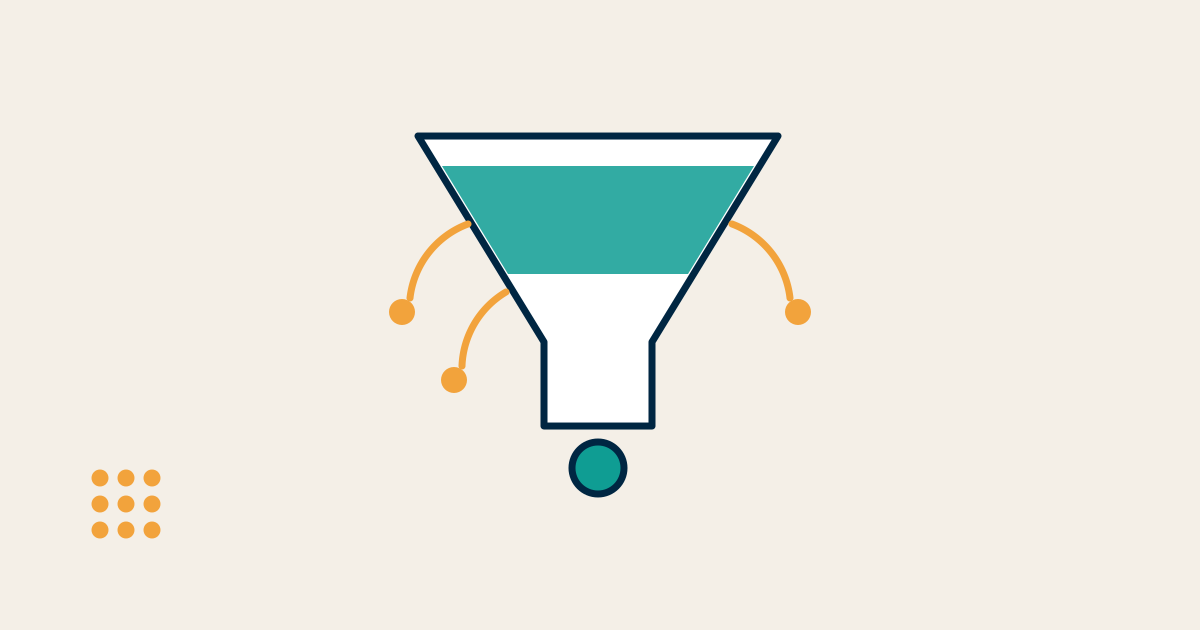
Concretely, an AI-native go-to-market engine has AI doing the heavy lifting across the full funnel, not just content drafting, which is the one place most agencies have added AI and stopped:
- Audience modelling: scoring which prospects actually resemble your best customers, refreshed on a schedule no analyst could keep up with by hand.
- Content production at volume: drafting across formats and channels continuously, not once a month when someone has time.
- Lead routing and first response: capturing and replying to enquiries within minutes of arrival, every time, regardless of who's in the office.
- Churn and lifecycle signals: watching customer behaviour continuously for the moment intervention actually matters, not on a quarterly review cycle.
Where humans still own the work, and why that matters
None of this means AI runs unsupervised. Humans own the judgment and the taste: what the brand actually sounds like, which leads deserve a founder's personal attention, what result is actually worth reporting versus what's just a vanity number. AI-native isn't "replace the team with a model." It's using the model to remove the busywork that used to require hiring more people, so a lean team can operate at a scale that used to need a much bigger one.
Why this distinction matters for the business hiring the agency
If your agency is AI-washed, you're paying for marginally faster execution of the same process every competitor's agency also runs. If your agency is AI-native, the system itself is different: faster iteration, tighter follow-up, and reporting that's actually current rather than reconstructed for a monthly meeting. The value isn't "they use AI." It's what that lets them actually deliver that a traditional agency structurally can't match at the same price.
Frequently asked questions
How can I tell if an agency is actually AI-native or just AI-washed? Ask what specifically breaks if the AI is removed. If the honest answer is "it gets slower," it's AI-washed. If the honest answer is "that part of the process stops entirely," it's AI-native.
Does AI-native mean less human involvement in my account? No, the opposite in the parts that matter. AI absorbs the repetitive, high-volume work so the humans on your account spend their time on judgment calls and strategy, not manual data entry or drafting from scratch.
Is AI-native marketing more expensive than a traditional agency? Usually less, for equivalent output, because AI absorbs work that would otherwise require additional headcount, which is exactly what lets a lean team compete with agencies several times its size.
See how our engine actually runs, or get a free Growth Leak Audit and we'll show you specifically where AI is and isn't doing the work in your current marketing.